Abstract
Photographs taken by blind and low-vision people are often blurred, dark or badly framed, and many of the questions asked about them cannot be answered from the image at all. We study visual question answering on VizWiz-VQA [1] with this in mind and treat “unanswerable” as a legitimate output rather than an error. Our model keeps two CLIP encoders [2] frozen, fuses the image and question embeddings as , and trains a single hidden layer with a 3,000-way answer classifier and an optional answerability head on soft VQA targets. On the official validation split (4,319 questions), plain CLIP-L/14@336 fusion reaches 54.22% VQA accuracy against 52.12% for always answering “unanswerable”. The answerability head ranks questions well (average precision 94.20%), but no threshold tuned on development data improved accuracy. The dominant failure is prediction collapse: the selected model answers “unanswerable” for 93.2% of validation questions and uses only 14 distinct answers. We report these results with an accessible prototype that pairs abstention with rule-based retake guidance.
All numbers on this page come from one executed run of our Milestone 2 notebook. They describe that experiment, not the public prototype, which runs a labelled demo provider (Section 6.2).
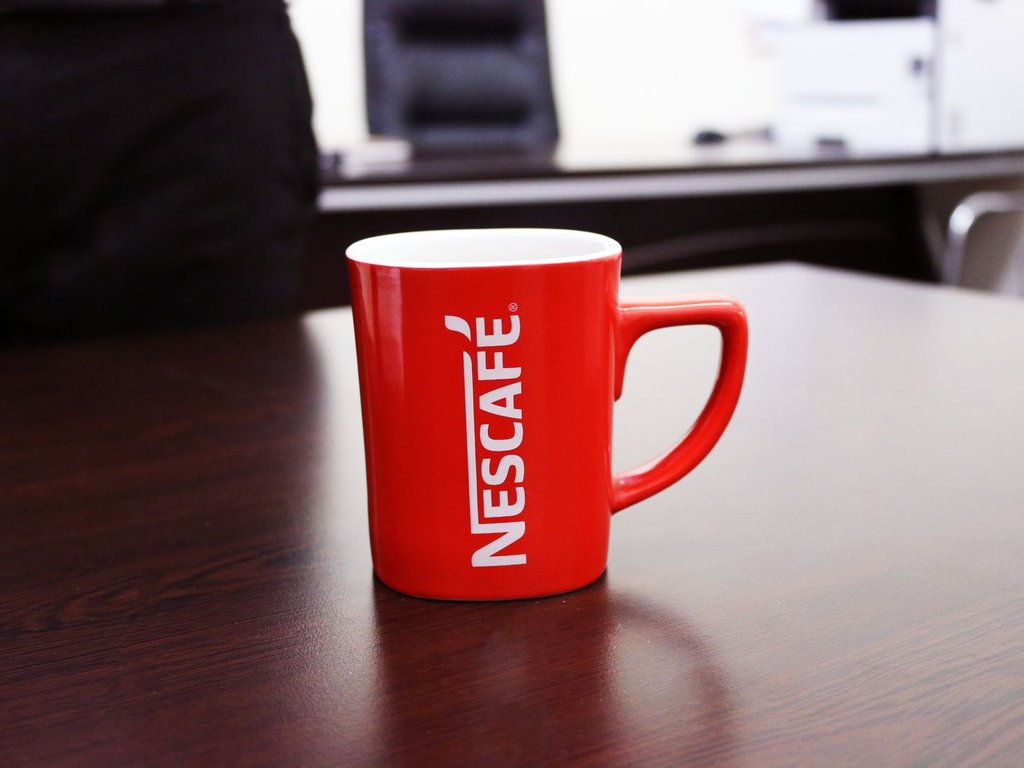
(a) “What color is the mug?” → red
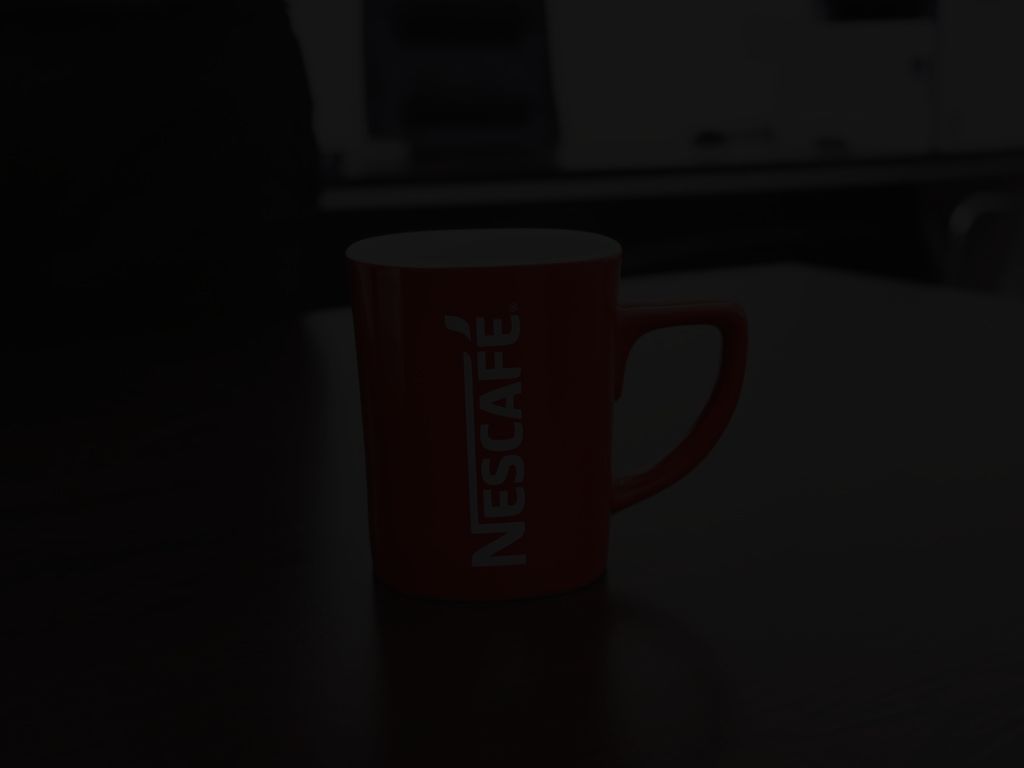
(b) Same question → unanswerable: “Please add light and retake it.”
1Introduction
VizWiz-VQA collects questions that blind people asked about photographs they took themselves [1]. Unlike curated benchmarks, many of its images are blurry, poorly lit or miss the object in question, and the questions are transcribed speech. In this setting a confident wrong answer can be worse than none, so a useful system must be able to say that an image does not support an answer, and ideally why.
We set out to measure how far a deliberately simple design goes: frozen CLIP features, a small fusion head and a fixed answer vocabulary, trained on a single T4 GPU. The work has three parts.
- A training and evaluation pipeline with soft VQA targets, cached features and seven configurations evaluated under one protocol (Sections 2 to 4).
- An analysis of the failure we observed, prediction collapse onto “unanswerable”, and of the ceiling imposed by a fixed vocabulary (Section 5).
- A web prototype that presents abstention together with image-quality diagnostics and retake guidance, designed for screen-reader, keyboard and low-vision use (Section 6).
The model improves on a constant baseline by about two percentage points. We report that result as it is, together with the reasons it is small.
2Data
2.1VizWiz-VQA and our splits
Each VizWiz question comes with ten crowd-sourced answers. We hold out 10% of the official training split as a development set for early stopping and threshold search, so the official validation split is used only for the final evaluation (Table 1). 73.0% of training questions are labelled answerable against 67.9% of validation questions, and “unanswerable” is the most frequent single answer, which makes the label distribution strongly imbalanced (Table 2).
Table 1. Splits of VizWiz-VQA used in our experiments.
| Split | Questions | Share of train | Use |
|---|---|---|---|
| Fit (training) | 18,471 | 90.0% | 90% of the official training set. Used to train the head. |
| Development | 2,052 | 10.0% | 10% of the official training set. Used only for early stopping and threshold tuning. |
| Official validation | 4,319 | n/a | Never used for model selection. All reported results are on this set. |
| Official test | 8,000 | n/a | Answers are not public, so there are no test metrics. Predictions can be submitted to the benchmark server. |
Fit and development partition the official training split (20,523 questions, seed 42). Test answers are not public, so no test results are reported.
Table 2. Answer-type distribution (percent of questions).
| Answer type | Train | Validation |
|---|---|---|
| Other | 66.9 | 62.3 |
| Unanswerable | 27.0 | 32.1 |
| Yes/no | 4.7 | 4.5 |
| Number | 1.5 | 1.1 |
| Mean question length (words) | 6.67 | 7.17 |
2.2Soft targets and the evaluation metric
Ten annotators rarely agree word for word, so we follow the standard VQA accuracy [3]. For a candidate answer and human answers ,
Averaging over the ten leave-one-out subsets gives 0.3, 0.6, 0.9 and 1.0 for answers named by one, two, three and four or more annotators. We use the same quantity as the training target for every answer in the vocabulary, so several plausible answers receive partial credit. For example, the question “What’s the name of this product?” received basil leaves seven times and basil three times, giving targets of 1.0 and 0.9. Figure 2 lets you vary the annotations.
| Answer | Annotators | Target | Bar |
|---|---|---|---|
| red | 4 / 10 | 1.00 | |
| orange | 3 / 10 | 0.90 | |
| unanswerable | 2 / 10 | 0.60 | |
| blue | 1 / 10 | 0.30 |
2.3Answer vocabulary
The classifier predicts one of the 3,000 most frequent normalised answers in the fit split. These cover 73.0% of fit-split human answers and 66.9% of development answers; 97.3% of fit questions have at least one in-vocabulary answer. Even a perfect classifier over this vocabulary could reach at most 82.53% VQA accuracy on the development split, and enlarging the vocabulary raises that ceiling only slowly (Figure 3).
3Method
3.1Architecture
Figure 4 shows the model. Images are converted to RGB, resized on the short side with bicubic interpolation, centre-cropped to 224 px (ViT-B/32) or 336 px (ViT-L/14) and normalised with CLIP’s mean and standard deviation. Questions are tokenised with CLIP’s byte-pair tokenizer and truncated to 77 tokens. Both encoders are frozen, and their L2-normalised outputs are extracted once and cached:
with for ViT-B/32 and for ViT-L/14@336. The fusion step has no parameters; the element-wise product gives the head a direct signal of where the two embeddings agree:
One hidden layer with dropout [6] feeds two linear heads:
For the head without the answerability output has 4,648,888 trainable parameters, the number printed in the notebook ( and with biases). The image-only and question-only baselines replace by or .
- Frozen, pre-trained CLIP
- Trained on VizWiz
- No parameters
- Optional answerability path
3.2Training objective
With soft targets from Eq. (1) and the binary answerable label , the loss for one question is
where . The first term is summed over the vocabulary and averaged over each batch; the second is present only when the answerability head is used.
3.3Decoding
By default the prediction is , which may itself be “unanswerable”. With the answerability head, a gated decoder abstains below a threshold searched on the development split:
The search found no threshold that beat argmax decoding (), so every gated result reported below equals argmax decoding.
3.4Implementation
We train with AdamW [4] and a cosine learning-rate schedule [5], select the epoch with the best development VQA accuracy and stop after five epochs without improvement (Table 3). Because the encoder features are cached, training touches only the head, which made seven configurations affordable on a single T4 GPU.
Table 3. Training and evaluation configuration, as run in the notebook.
| Setting | Value |
|---|---|
| Encoders (frozen) | OpenAI CLIP ViT-B/32 (224 px) and ViT-L/14 at 336 px |
| Fusion | [v, q, v ⊙ q] |
| Head | Linear(3d → 1,024) → ReLU → Dropout(0.5) → Linear(3,000) |
| Answerability head | Linear(1,024 → 1) on the same hidden layer; loss weight 1.0 |
| Loss | Binary cross-entropy with logits on soft VQA targets (summed over the vocabulary) |
| Optimizer | AdamW, learning rate 1e-3, weight decay 1e-4 |
| Schedule | Cosine annealing over 30 epochs |
| Batch size / epochs | 256 / up to 30 |
| Early stopping | Development VQA accuracy, patience 5 |
| Seed | 42 |
| Hardware | NVIDIA Tesla T4 |
| Trainable parameters (B/32 head) | 4,648,888 |
| Feature caching | Frozen CLIP image and question features are extracted once and cached |
4Results
4.1Main results
Table 4 compares all seven configurations. Question-only and image-only heads collapse to the constant answer and score exactly 52.12%. Fusion with CLIP-B/32 adds 1.12 points; the larger CLIP-L/14@336 encoder adds a further 0.98, lowering validation error from 46.76% to 45.78%, a 2.10% relative reduction. The answerability head has little effect on accuracy. The model selected on development accuracy is L/14@336 with the head (54.14%), slightly below plain L/14@336 fusion (54.22%), which is the best result on validation.
Table 4. Results on the official VizWiz-VQA validation split (4,319 questions). All values in percent, from a single run (seed 42). Bold marks the best value in each metric column.
| Model | VQA acc. | Ans. F1 | Unans. F1 | AP | Pred. unans. |
|---|---|---|---|---|---|
| Baselines | |||||
| Always “unanswerable” | 52.12 | 0.00 | 48.56 | n/a | 100.00 |
| Question only | 52.12 | 0.00 | 48.56 | 80.90 | 100.00 |
| Image only | 52.12 | 0.00 | 48.56 | 84.94 | 100.00 |
| CLIP ViT-B/32, d = 512 | |||||
| Fusion | 53.24 | 12.57 | 50.19 | 92.51 | 95.35 |
| + answerability head, argmax | 53.04 | 11.85 | 50.08 | 92.98 | 95.62 |
| + answerability head, gated | 53.04 | 11.85 | 50.08 | 92.98 | 95.62 |
| CLIP ViT-L/14@336, d = 768 | |||||
| Fusion | 54.22 | 17.73 | 50.96 | 93.76 | 93.24 |
| + answerability head, gated † | 54.14 | 17.67 | 50.92 | 94.20 | 93.24 |
VQA acc.: Eq. (1) averaged over questions. Ans. F1 and Unans. F1: F1 score with “answerable” or “unanswerable” as the positive class, where any prediction other than “unanswerable” counts as answering. AP: average precision of pans for ranking answerable questions; for models without an answerability head we use 1 − σ(sunans), and the constant baseline has no score. Pred. unans.: share of questions answered “unanswerable”.
† Selected on development-split VQA accuracy. The threshold search chose no threshold (τ = None), so gated rows equal argmax decoding; the two B/32 head rows are therefore identical.
4.2Training dynamics
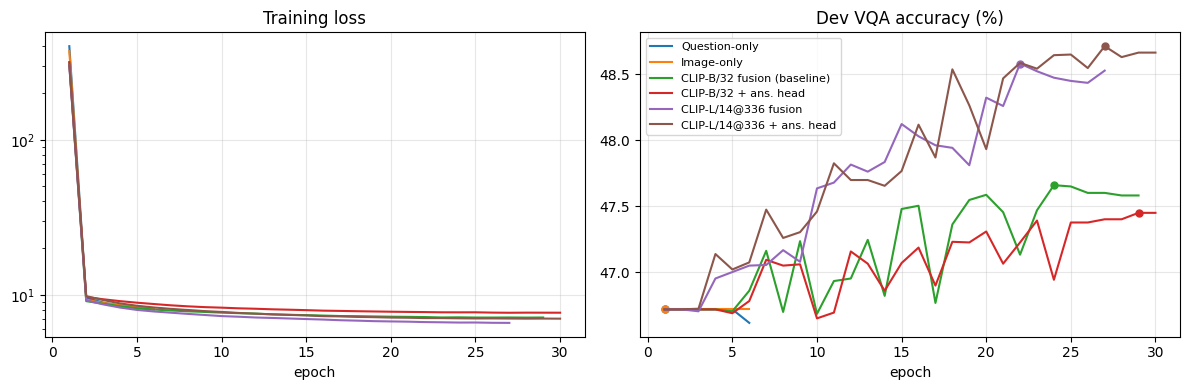
All three main runs start at the development accuracy of the constant answer (46.72%) and improve slowly (Figure 5). The L/14@336 runs separate from B/32 after about ten epochs; early stopping keeps epochs 24, 22 and 27.
- CLIP-B/32 fusion
- CLIP-L/14@336 fusion
- CLIP-L/14@336 + answerability head
Values as a table
| Epoch | CLIP-B/32 fusion | CLIP-L/14@336 fusion | CLIP-L/14@336 + answerability head |
|---|---|---|---|
| 1 | 46.72 | 46.72 | 46.72 |
| 2 | 46.72 | 46.72 | 46.72 |
| 3 | 46.72 | 46.71 | 46.73 |
| 4 | 46.72 | 46.95 | 47.14 |
| 5 | 46.71 | 47.00 | 47.02 |
| 6 | 46.86 | 47.05 | 47.08 |
| 7 | 47.16 | 47.06 | 47.48 |
| 8 | 46.70 | 47.17 | 47.26 |
| 9 | 47.24 | 47.08 | 47.31 |
| 10 | 46.69 | 47.64 | 47.46 |
| 11 | 46.93 | 47.68 | 47.83 |
| 12 | 46.95 | 47.82 | 47.70 |
| 13 | 47.25 | 47.76 | 47.70 |
| 14 | 46.82 | 47.84 | 47.66 |
| 15 | 47.48 | 48.12 | 47.77 |
| 16 | 47.50 | 48.03 | 48.12 |
| 17 | 46.77 | 47.96 | 47.87 |
| 18 | 47.36 | 47.94 | 48.54 |
| 19 | 47.55 | 47.81 | 48.27 |
| 20 | 47.59 | 48.32 | 47.93 |
| 21 | 47.46 | 48.26 | 48.47 |
| 22 | 47.13 | 48.58 | 48.59 |
| 23 | 47.47 | 48.52 | 48.54 |
| 24 | 47.66 | 48.47 | 48.65 |
| 25 | 47.65 | 48.45 | 48.65 |
| 26 | 47.60 | 48.44 | 48.55 |
| 27 | 47.60 | 48.53 | 48.71 |
| 28 | 47.58 | stopped | 48.63 |
| 29 | 47.58 | stopped | stopped |
4.3Accuracy by answer type
Gains concentrate in yes/no and “other” questions (Table 5). Number accuracy is identical for every model and equal to the constant baseline, which is consistent with the models abstaining on counting questions.
Table 5. VQA accuracy by annotated answer type on the validation split (percent).
| Model | Overall | Yes/no | Number | Other | Unans. |
|---|---|---|---|---|---|
| Always “unanswerable” | 52.12 | 36.82 | 33.96 | 28.91 | 100.00 |
| B/32 fusion | 53.24 | 37.85 | 33.96 | 30.75 | 99.78 |
| B/32 + answerability head | 53.04 | 36.82 | 33.96 | 30.51 | 99.75 |
| L/14@336 fusion | 54.22 | 43.08 | 33.96 | 32.00 | 99.65 |
| L/14@336 + answerability head † | 54.14 | 44.26 | 33.96 | 31.86 | 99.54 |
Question-only and image-only models equal the constant baseline in every column and are omitted. Number accuracy is identical for all models. The Unans. column rewards abstaining, so a high value there is not evidence of skill and is not bolded.
4.4Answerability
Table 6 separates the two kinds of error. Every model is nearly perfect on questions that humans marked unanswerable and poor on answerable ones: the selected model answers 285 of 2,934 answerable questions and abstains on the other 2,649 (90.3%). It rarely answers wrongly because it rarely answers at all.
Table 6. Answerability on the validation split: 1,385 questions are labelled unanswerable and 2,934 answerable. Each cell gives the count and its share of the row; shading is proportional to that share.
| Model | Label | Predicted “unanswerable” | Predicted an answer |
|---|---|---|---|
| B/32 fusion | Unanswerable | 1,381 (99.7%) | 4 (0.3%) |
| Answerable | 2,737 (93.3%) | 197 (6.7%) | |
| B/32 + answerability head | Unanswerable | 1,381 (99.7%) | 4 (0.3%) |
| Answerable | 2,749 (93.7%) | 185 (6.3%) | |
| L/14@336 + answerability head † | Unanswerable | 1,378 (99.5%) | 7 (0.5%) |
| Answerable | 2,649 (90.3%) | 285 (9.7%) |
† The model selected on development accuracy.
5Analysis
5.1Prediction collapse
The selected model predicts “unanswerable” for 93.2% of validation questions, while the human majority answer is “unanswerable” for only 43.3%. Of the 3,000 answers it could produce it uses 14, mostly colours (Figure 6). A plausible cause, which we did not test, is the combination of a dominant answer class, which binary cross-entropy makes a low-risk default, and frozen, pooled CLIP features that give the head little evidence to override it.
Selected model’s predictions
| unanswerable | 93.2% |
|---|---|
| grey | 2.5% |
| white | 0.9% |
| yes | 0.9% |
| black | 0.7% |
| blue | 0.5% |
| phone | 0.4% |
| dog | 0.3% |
| remote | 0.1% |
| beer | 0.1% |
Human majority answer
| unanswerable | 43.3% |
|---|---|
| no | 2.4% |
| yes | 2.3% |
| white | 1.4% |
| blue | 1.0% |
| black | 0.9% |
| grey | 0.9% |
| laptop | 0.7% |
| computer screen | 0.5% |
| brown | 0.5% |
5.2Questions that require reading
About 17% of validation questions ask for text. In the notebook’s error analysis these score higher (about 66%) than other questions (about 52%); both values are read from a figure. This is not evidence that the model can read: it has no OCR component. The likely explanation, which we did not test separately, is that many text questions are unanswerable from the photograph and humans said so, so a model that abstains receives credit.
5.3Diagnostics attached to abstentions
When the model abstains, the prototype names a likely cause using rule-based measurements on a grayscale copy of at most 1024 px: mean brightness below 45 or above 220 (of 255), a Laplacian variance below 60, or more than 55% of pixels near black (at most 10) or near white (at least 245). Figure 7 shows how often each reason fired on the validation abstentions. VizWiz has no ground-truth reason labels, so we cannot say how often these diagnostics are right; they are heuristics, not learned explanations.
| Not enough visible evidence | ≈ 1,970 |
|---|---|
| Likely blurry | ≈ 1,440 |
| Text likely unclear | ≈ 450 |
| Likely too dark | ≈ 100 |
| Likely overexposed | ≈ 35 |
6Prototype
6.1From abstention to a retake
The prototype wraps the model in one flow. A photo is checked on the device for brightness, blur and clipped exposure before anything is uploaded; it is sent only after explicit consent, re-encoded to remove location and camera metadata, and deleted by the server once answered. The person asks one question by typing or voice and receives either a short answer or an abstention with a retake instruction derived from the same measurements, while the question is kept so only the photo needs replacing. Questions about medication, money, safety or navigation add a reminder to confirm another way. The interface is designed for keyboard, screen-reader and low-vision use, with high-contrast and large-text modes.
Figure 8 lists the scripted cases bundled with the prototype. They demonstrate interface states, not model quality.
(a)Red mug on a desk
- Question
- What color is the mug?
- Scripted demo answer
- red
- Why
- Even lighting and a centred subject. A one-word colour answer is supported by the image.
6.2Inference providers
The API serves three interchangeable providers behind one interface: a demo provider, a local provider that runs the exported head with NumPy on CLIP features, and a remote provider. The trained weights remain in the Kaggle session, so the public deployment runs the demo provider. Demo responses are labelled throughout the interface, and the API never falls back silently from a real model to the demo.
To run the trained head, export head.npz, vocab.json and config.json from the notebook, install the API’s model extra and set ASKSIGHT_PROVIDER=local with ASKSIGHT_MODEL_BUNDLE_DIR. A hosted model uses ASKSIGHT_PROVIDER=remote with ASKSIGHT_REMOTE_URL. Full steps are in docs/model-integration.md.
Status of the connected API
Checking the inference API…
7Limitations
- One run. All results come from a single seed and split, without confidence intervals or significance tests. Values marked as approximate were read from figures.
- Fixed vocabulary. The classifier cannot produce rare or unseen answers, and its ceiling on the development split is 82.53%.
- No text recognition. Labels, dates, brands and product names are unreliable.
- Frozen, pooled features. A single vector per image loses spatial detail, and the encoders cannot adapt to blur, darkness or unusual framing.
- Collapse. The model over-predicts “unanswerable” and uses only 14 distinct answers.
- Uncalibrated scores. Answer scores rank candidates but are not probabilities of being right.
- Heuristic diagnostics. Retake reasons are rule-based pixel measurements that have not been validated against labels.
- Not evaluated with users. The prototype has passed automated accessibility checks but has not been tested with blind or low-vision participants. It must not be the only source for decisions about health, safety, money, medication or navigation.
8Future work
- OCR for text-reading questions. We would add text recognition so labels, dates and brand names can be read instead of guessed from a fixed list.
- Question-guided patch attention. We would let the question attend to CLIP patch tokens (49 or 576 per image) instead of one pooled vector, so small relevant regions are found.
- Better class-imbalance handling. We would try re-weighting, focal loss, or sampling so the model does not collapse onto the dominant answer.
- Fine-tuning or parameter-efficient adaptation. We would adapt the last CLIP blocks (partial fine-tuning or LoRA) to blurry, badly framed phone photos.
- Generative answering. We would move beyond a fixed 3,000-answer vocabulary so rare and unseen answers become possible.
- Better calibration. We would calibrate scores so reliability wording reflects how often the model is actually right.
- Supervised image-quality reasoning. We would collect reason labels so abstention explanations are learned and evaluated, not just rule-based diagnostics.
References
- [1]D. Gurari, Q. Li, A. J. Stangl, A. Guo, C. Lin, K. Grauman, J. Luo, J. P. Bigham. VizWiz Grand Challenge: Answering Visual Questions from Blind People (opens in a new tab). IEEE/CVF Conference on Computer Vision and Pattern Recognition (CVPR), 2018.
- [2]A. Radford, J. W. Kim, C. Hallacy, A. Ramesh, G. Goh, S. Agarwal, G. Sastry, A. Askell, P. Mishkin, J. Clark, G. Krueger, I. Sutskever. Learning Transferable Visual Models From Natural Language Supervision (opens in a new tab). International Conference on Machine Learning (ICML), 2021.
- [3]S. Antol, A. Agrawal, J. Lu, M. Mitchell, D. Batra, C. L. Zitnick, D. Parikh. VQA: Visual Question Answering (opens in a new tab). IEEE International Conference on Computer Vision (ICCV), 2015.
- [4]I. Loshchilov, F. Hutter. Decoupled Weight Decay Regularization (opens in a new tab). International Conference on Learning Representations (ICLR), 2019.
- [5]I. Loshchilov, F. Hutter. SGDR: Stochastic Gradient Descent with Warm Restarts (opens in a new tab). International Conference on Learning Representations (ICLR), 2017.
- [6]N. Srivastava, G. Hinton, A. Krizhevsky, I. Sutskever, R. Salakhutdinov. Dropout: A Simple Way to Prevent Neural Networks from Overfitting (opens in a new tab). Journal of Machine Learning Research 15(56): 1929–1958, 2014.
ANotebook outputs
For verification, Figure A1 reproduces output cells from the executed notebook. Section numbers refer to the notebook.